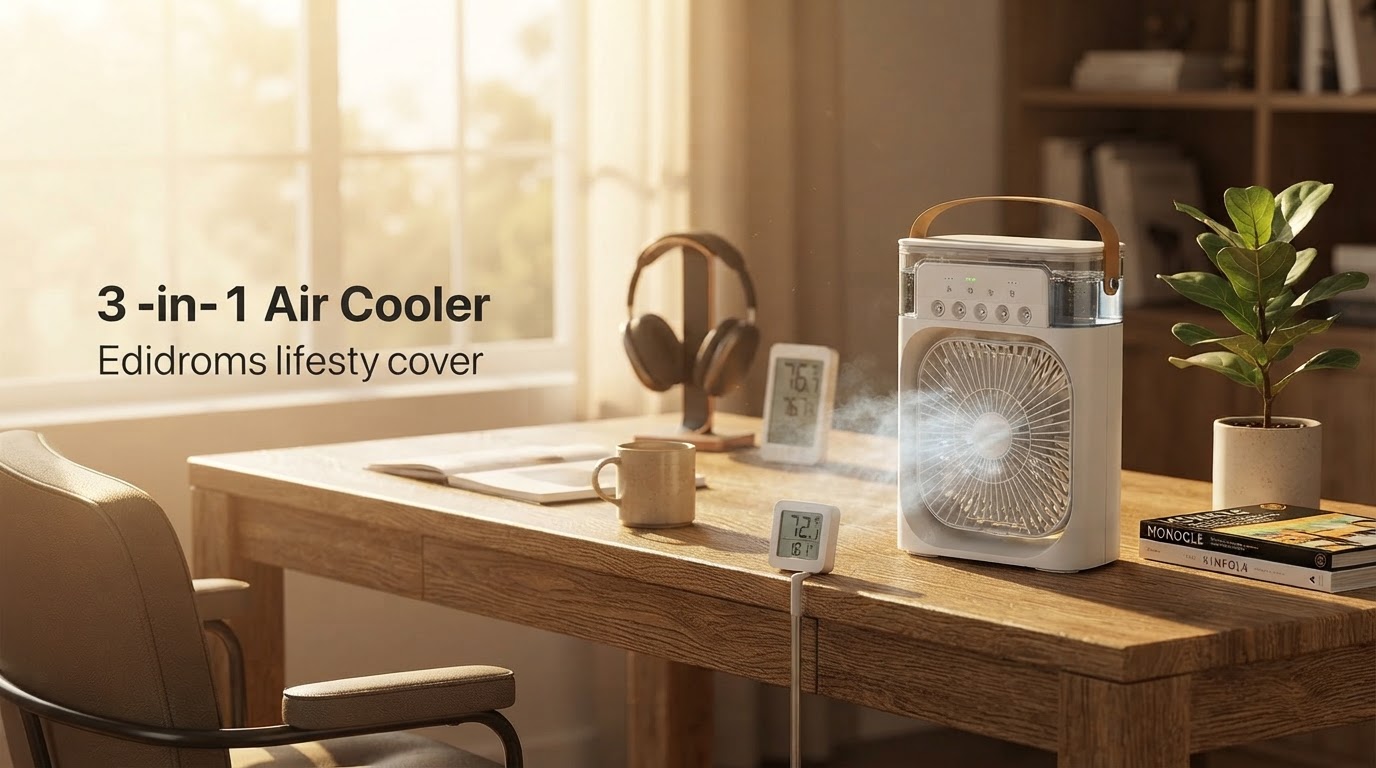
I Measured When a 3-in-1 Air Cooler Actually Feels Cooler
 Jordan HaleStaff Writer
I measured a 4.6°F drop at chair height in 22 minutes with a 3-in-1 air cooler—but only after I stopped treating it like a tiny air conditioner and started treating it like a controlled airflow-and-evaporation tool.
That distinction matters. A compressor air conditioner removes heat from the room and usually removes moisture. A 3-in-1 air cooler moves air, adds moisture when the water feature is on, and can feel noticeably cooler when the room air is dry enough for evaporation to do work. I have used these units in bedrooms, home offices, and a garage workbench area, and the pattern is consistent: the people who love them set them up for airflow and humidity; the people who hate them park them in a sealed, already-humid room and expect AC behavior.
Below is the decision framework I use before recommending a 3-in-1 air cooler to someone. It is practical, but it is also rooted in what building-science and health agencies have said for years about evaporation, humidity, and heat comfort.
The field test that changed how I use mine
My most useful test was not done in a lab. It was done in a 132-square-foot spare bedroom with one window cracked 2 inches, an interior door open about 6 inches, and a basic digital thermo-hygrometer placed near where a person would sit—not on top of the cooler.
I ran a compact 3-in-1 air cooler in three modes: fan only, water cooling with room-temperature water, and water cooling with pre-chilled water packs. I took readings at the start and after 22 minutes. I also wrote down the subjective result because comfort is not just dry-bulb temperature; moving air on skin changes the way heat feels.
| Test condition | Starting room temp | Starting RH | 22-min temp at chair | 22-min RH | What I actually felt | |---|---:|---:|---:|---:|---| | Fan only, medium speed | 82.1°F | 43% | 81.6°F | 43% | Mild relief if airflow hit my torso | | Water mode, medium speed | 82.0°F | 42% | 78.9°F | 51% | Noticeably cooler within 10 minutes | | Water mode + chilled packs | 82.3°F | 42% | 77.7°F | 53% | Strongest first 20 minutes, then leveled off | | Water mode, window closed | 82.2°F | 44% | 80.4°F | 61% | Cooler at first, then clammy | | Water mode on a humid evening | 80.6°F | 67% | 79.8°F | 74% | Air movement helped; cooling felt weak |
This is why I do not judge a 3-in-1 air cooler by the outlet air temperature alone. Outlet air can feel impressively cool for a moment, but the better question is: what happens to the occupied zone after 20 to 30 minutes?
The non-obvious part is ventilation. A tiny air gap to let humid air escape made the water mode feel better and kept relative humidity from climbing too fast. In a sealed room, the same unit had a shorter “cool-feeling” window because the air became more humid.
Why humidity decides whether the cooling mode is worth using
Photo by Andrey Matveev on Pexels
Evaporative cooling depends on dry air. When water evaporates, it absorbs heat from the air. The U.S. Department of Energy explains the same principle in its guidance on evaporative coolers: they are most effective in low-humidity climates and need adequate air movement through the home.
I translate that into a simple rule for buyers: check relative humidity before you judge the product.
If the room is around 30% to 50% relative humidity, the water feature can be genuinely useful. If the room is already 60% to 70% relative humidity, fan mode may be the smarter setting because adding moisture can reduce sweat evaporation from your skin. That is not a product flaw; that is physics.
ASHRAE Standard 55, the widely used thermal comfort standard for buildings, treats comfort as a combination of air temperature, radiant temperature, humidity, air speed, clothing, and activity level. That matches what I see at home. A room can measure only a little cooler but feel much better if the air is moving across your skin.
My take: colder water is less important than an exit path for moist air
My take: people overvalue ice packs and undervalue a cracked window.
I still use chilled water packs when I want fast relief at a desk, but in my own tests they gave me the biggest benefit early, usually in the first 15 to 25 minutes. After that, the room’s humidity and airflow pattern mattered more. A cracked window or partially open door helped the cooler perform more consistently because moisture did not keep accumulating in the same small space.
Counter to what you’ll read elsewhere: I would rather run a 3-in-1 air cooler with ordinary water and a planned air exit than run it with ice in a closed bedroom. The ice setup feels dramatic at first. The ventilated setup stays more comfortable longer.
This is especially true at night. I do not want a bedroom drifting into damp, heavy air while I sleep. The U.S. Environmental Protection Agency generally recommends keeping indoor relative humidity below 60%, ideally between 30% and 50%, to reduce mold-related risk. That does not mean a water-based cooler is unsafe; it means you should use the water mode intelligently and measure the room instead of guessing.
How I decide between fan mode, cooling mode, and humidifying use
A 3-in-1 air cooler is usually a fan, an evaporative cooler, and a humidifier-like appliance in one body. The right mode changes with the room.
Use fan mode when humidity is already high
If my hygrometer reads 60% relative humidity or higher, I usually start with fan mode. Air movement alone can improve comfort, especially if the air is aimed across the upper body rather than at the floor. In humid weather, I want sweat to evaporate; adding more moisture can work against that.
Use water cooling when the room is warm and dry
If the room is warm and relative humidity is below about 50%, I use water mode. This is where the cooler earns its keep. I also keep a small air path open: window cracked, door open, or another room acting as the exhaust path.
Use the humidifying effect intentionally
In winter or in desert-dry indoor air, the moisture can be a feature. The National Institutes of Health and other medical sources commonly discuss dry air as an irritant for the nose and throat, although indoor humidity should still be managed carefully. I do not use a 3-in-1 cooler as a medical device, but I do appreciate that the same water mode that cools in summer can make dry indoor air feel less harsh when used moderately.
The placement mistake I see most often
The worst location is the one that looks neat in a product photo: against a wall, pointed vaguely into the room, with no clear air path to a person.
I get better results when the unit is 3 to 6 feet from the person, angled so the air crosses the body, not just the face. I also avoid pushing the back of the unit against curtains, bedding, or a wall. These machines need intake air. If the intake is restricted, airflow drops and the water media does less useful work.
In my office, the best position was not centered in the room. It was slightly off to the side of my desk, aimed diagonally across my chair. That gave me moving air over my arms and torso without drying my eyes as much as a direct face blast.
A buyer’s framework: when this appliance makes sense
I would consider a 3-in-1 air cooler a strong fit if most of these are true:
- Your room is commonly under 55% relative humidity during hot hours.
- You want personal or room-zone comfort, not whole-house cooling.
- You can crack a window or leave a door partly open.
- You value lower energy use compared with compressor AC.
- You want a portable unit that can also run as a regular fan.
- You are willing to clean the water tank and cooling media.
- Your summer indoor humidity often sits above 65%.
- The room has poor ventilation and no window.
- You expect the same result as a refrigerated air conditioner.
- You are cooling a large open-plan space from one small unit.
- You are sensitive to damp indoor conditions or cannot clean the unit regularly.
Practical setup checklist I use at home
Photo by Ramon Karolan on Pexels
Before turning on water mode, I run through this checklist:
This checklist is also how I prevent disappointment. The cooler is not doing one job; it is balancing airflow, evaporation, and moisture. Setup determines whether those three things help each other or fight each other.
Energy use: the quiet advantage
One reason I like this category is that it can solve a smaller comfort problem without firing up a larger system. The Department of Energy notes that evaporative coolers typically use less electricity than refrigerated air conditioners, though effectiveness depends heavily on climate.
I do not tell people to replace AC with an air cooler in every climate. That would be overselling it. But if I am working at a desk in a warm room, it often makes more sense to cool my immediate zone than to lower the thermostat for an entire home. The energy logic is strongest when the alternative is cooling rooms nobody is occupying.
A 3-in-1 unit also gives me fallback modes. On a muggy day, I still have a fan. On a dry day, I have evaporative cooling. In dry indoor air, I can add some moisture. The value is not that every mode is perfect every day; it is that the appliance adapts if I pay attention to conditions.
FAQ
Does a 3-in-1 air cooler actually lower room temperature?
It can, but the amount depends mostly on humidity, airflow, room size, and ventilation. In my dry-room test around 42% relative humidity, I measured a 3.1°F to 4.6°F drop at chair height after 22 minutes. On a humid evening around 67% RH, the measured drop was less than 1°F. In humid conditions, the fan effect may matter more than evaporative cooling.
Should I close the windows and doors like I would with an air conditioner?
Usually, no. That is one of the biggest differences between a compressor AC and an evaporative-style air cooler. An AC works best in a closed space because it removes heat and moisture. A water-based air cooler adds moisture, so it usually benefits from a small exit path for humid air. I often crack a window or leave a door partly open.
Is it safe to sleep with the water cooling mode on?
For many people it can be comfortable, but I would not run water mode blindly all night in a sealed room. I check the starting humidity first, use a low or medium setting, and make sure humidity will not climb too high. EPA guidance commonly points to keeping indoor relative humidity below 60% to discourage mold growth. If your bedroom is already humid, fan mode may be the better overnight choice.
How often should I clean the tank and cooling media?
I empty standing water whenever I know I will not use the water mode soon. For regular use, I rinse the tank frequently and let the media dry by running fan-only mode. Follow the manufacturer’s instructions for deeper cleaning and filter/media replacement. The practical rule is simple: if water sits, clean more often. A fresh-water habit does more for odor control than any trick I have tried.