The Eco-Friendly Cooling Fallacy: A Data-First Analysis
 Maya ChenContributing Editor
The conventional wisdom says eco-friendly cooling means using the device with the lowest possible power draw, which has crowned wearable neck fans as the sustainable champion. This perspective is fundamentally flawed. It mistakes minimal device-level wattage for meaningful environmental impact, ignoring the larger context of household energy consumption. The true measure of an "eco-friendly" cooling device is its ability to reduce the workload of a home's primary, high-consumption HVAC system. By this standard, wearables fail.
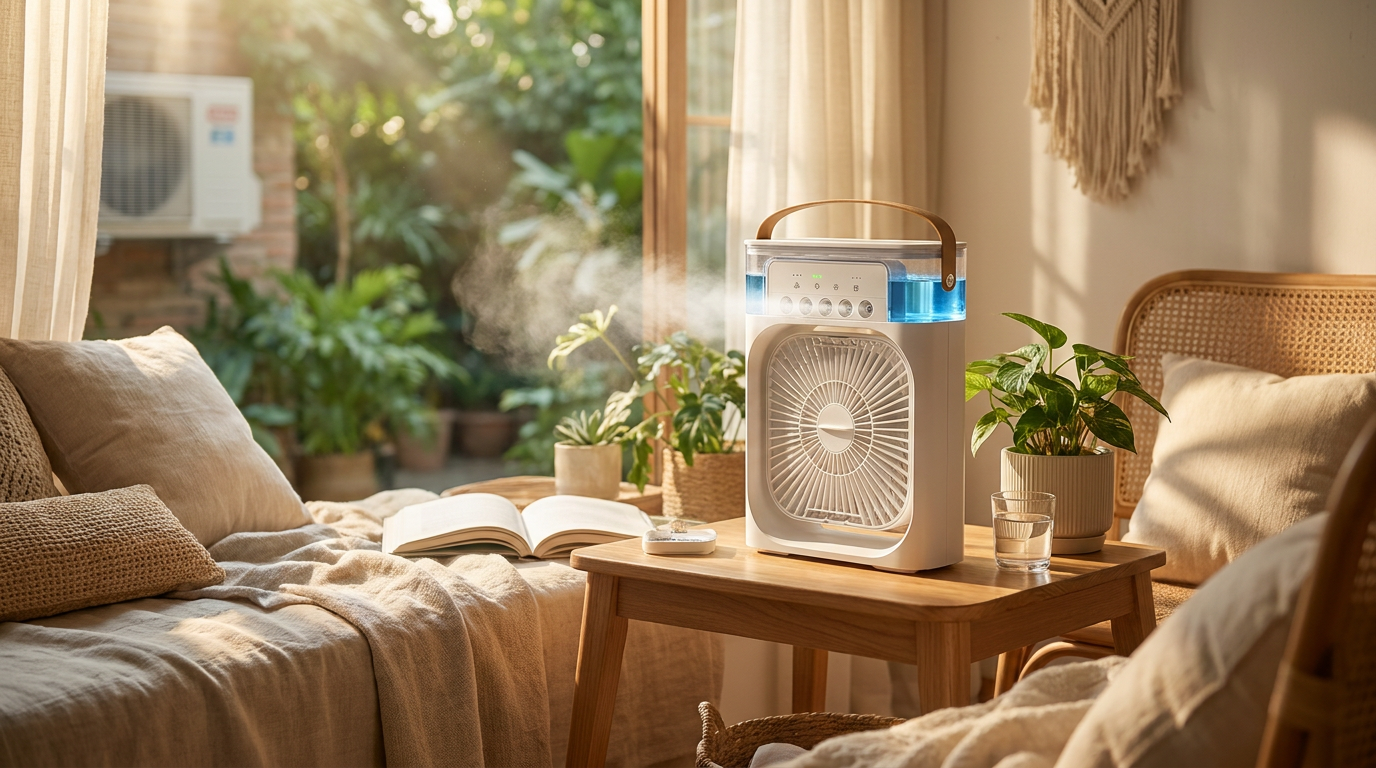
Here's the part nobody talks about: a neck fan is an energy addition, not a substitute. It makes a hot walk more bearable, but it doesn't allow you to turn off your central air conditioning. A stationary device like the 3-In-1 Air Cooler, however, operates on a different principle. By creating a localized zone of comfort on a desk or bedside table, it enables a user to raise their home's main thermostat. According to the U.S. Department of Energy, raising your thermostat by just 7-10°F for 8 hours a day can cut annual cooling costs by up to 10% source. This reduction in HVAC runtime is where significant energy savings are realized.
Run the math: A central AC unit can consume 3,500 watts. A window unit might use 900 watts. The 3-In-1 Air Cooler uses about 10 watts. A neck fan uses about 5 watts. The 5-watt difference between a neck fan and a desktop evaporative cooler is trivial. The real prize is the hundreds or thousands of watts saved by allowing the central AC to cycle less frequently. For this strategy to work, the device must be effective enough to make a warmer room feel comfortable, which is why optimizing a cooler for a small workspace is critical.
Furthermore, the analysis must extend beyond electricity usage to the cooling medium itself. Vapor-compression air conditioners rely on chemical refrigerants (HFCs), which have a global warming potential thousands of times greater than CO2 if they leak. Evaporative coolers like the 3-In-1 use only water, eliminating refrigerant-related environmental risk entirely. When considering why to choose a 3-in-1 portable air cooler, this chemical-free operation is a primary factor.
I'll change my mind when a wearable device can demonstrate a measurable reduction in a home's HVAC runtime. Until then, the most credible eco-friendly claim belongs not to the lowest-wattage gadget, but to the stationary personal cooler that makes a higher thermostat setting tolerable as part of a thoughtful home integration strategy.
Is an evaporative cooler effective in all climates?
No. The cooling effect of evaporative technology is directly tied to the evaporation rate of water, which is highest in dry, low-humidity environments. In humid climates, the air is already saturated with moisture, significantly reducing the device's ability to lower the perceived temperature. In these regions, it functions primarily as a fan with a misting feature, providing less of a cooling benefit.How does a personal cooler actually reduce overall energy use?

Photo by Max Vakhtbovych on Pexels
A personal cooler reduces energy consumption indirectly. By creating a concentrated cool zone around the user, it provides comfort without having to cool an entire room or house to the same temperature. This allows the user to set their main air conditioner's thermostat several degrees higher, causing the high-wattage HVAC system to run less often and for shorter durations, which results in substantial overall energy savings.