Rethinking Workspace Cooling: Focus Over Brute Force
 Maya ChenContributing Editor
Most guides rank personal coolers on raw cooling power, but the most important metric for your workspace is actually how they preserve your cognitive focus. The goal isn't to replicate arctic conditions in a 100-square-foot office; it's to create a personal micro-climate that eliminates the physical discomforts that constantly shatter deep work. The difference between a productive afternoon and a draining one often comes down to the quality of the air in your immediate breathing zone.
The Conventional Flaws in Personal Cooling
The conventional wisdom says to fight heat with either a powerful air conditioner or a simple desk fan. Both approaches are flawed for focused work. Aggressive compressor-based air conditioning strips the air of moisture, dropping humidity to levels that cause dry eyes, scratchy throats, and sinus irritation. According to the U.S. Environmental Protection Agency, ideal indoor humidity sits between 30-50%; aggressive AC can easily push it below that, creating a constant physical distraction. Here's the part nobody talks about: desk fans are even worse. They do nothing to combat the localized 'tech-heat' radiating from laptops and monitors, instead just circulating hot, stagnant air that contributes to mental fatigue. Neither method addresses the core problem.
Engineering a Micro-Climate for Cognitive Performance

Photo by Wolrider YURTSEVEN on Pexels
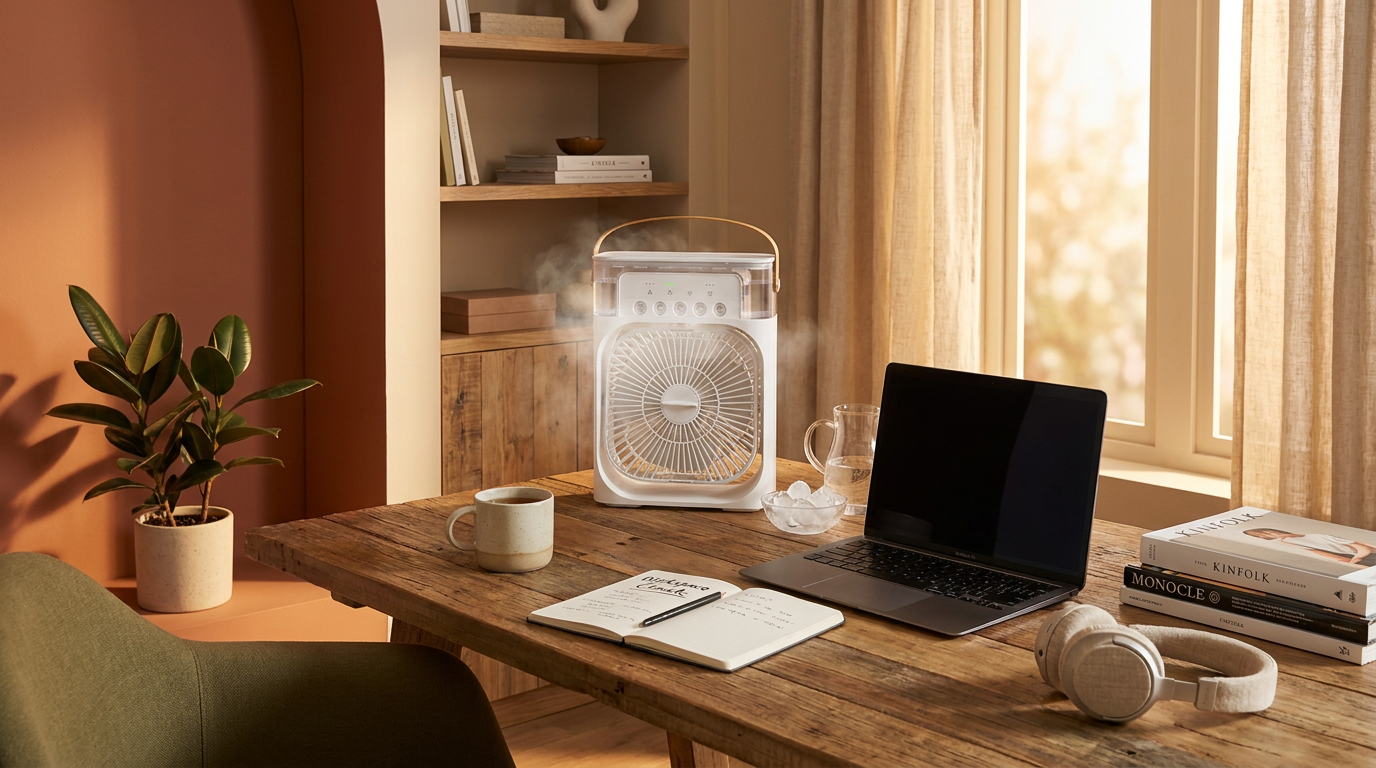
Effective personal cooling is about stability, not brute force. The 3-In-1 Air Cooler operates on the principle of evaporative cooling, a process that adds essential moisture to the air as it lowers the temperature. This creates a stable, humidified micro-climate around your workstation, directly countering the dry, irritating environment created by central HVAC. It prevents the physical discomforts that pull you out of a flow state.
Run the math: a portable AC unit can draw over 1,000 watts to cool a room, while the USB-powered 3-In-1 Air Cooler maintains a consistent 5-to-10 degree drop in your personal space using a fraction of that energy. This targeted approach is a core component of its design. By humidifying the air, it also sidesteps the central argument against many coolers by embracing a more holistic view of comfort, a concept often missing in discussions about eco-friendly personal cooling fan technology. For those who value efficiency, understanding why to choose a 3 in 1 portable air cooler starts with prioritizing focus over raw, untargeted power. Proper upkeep is minimal, but following a basic portable air cooler maintenance checklist ensures the unit operates at peak efficiency without introducing contaminants.
I'll change my mind when compressor-based technology can be miniaturized to the size of a coffee mug without needing an exhaust hose. Until then, for focused desk work, managing the immediate thermal envelope with an evaporative cooler is the only logical choice.
How does a compact air cooler improve focus more than a fan?
A standard desk fan only circulates existing hot, stagnant air, doing nothing to mitigate the heat from electronics or the dryness from central AC. An evaporative cooler like the 3-In-1 actively cools the air while adding humidity, creating a stable micro-climate that prevents the dry eyes and respiratory irritation known to break concentration.
Is an evaporative cooler effective in any small workspace?
Photo by Max Vakhtbovych on Pexels
Evaporative cooling is most effective in environments where the relative humidity is below 60%. In very humid climates, its ability to cool the air is diminished. The device excels at creating a personal comfort zone at a desk rather than lowering the temperature of an entire room, making it ideal for targeted relief in a shared or small office.