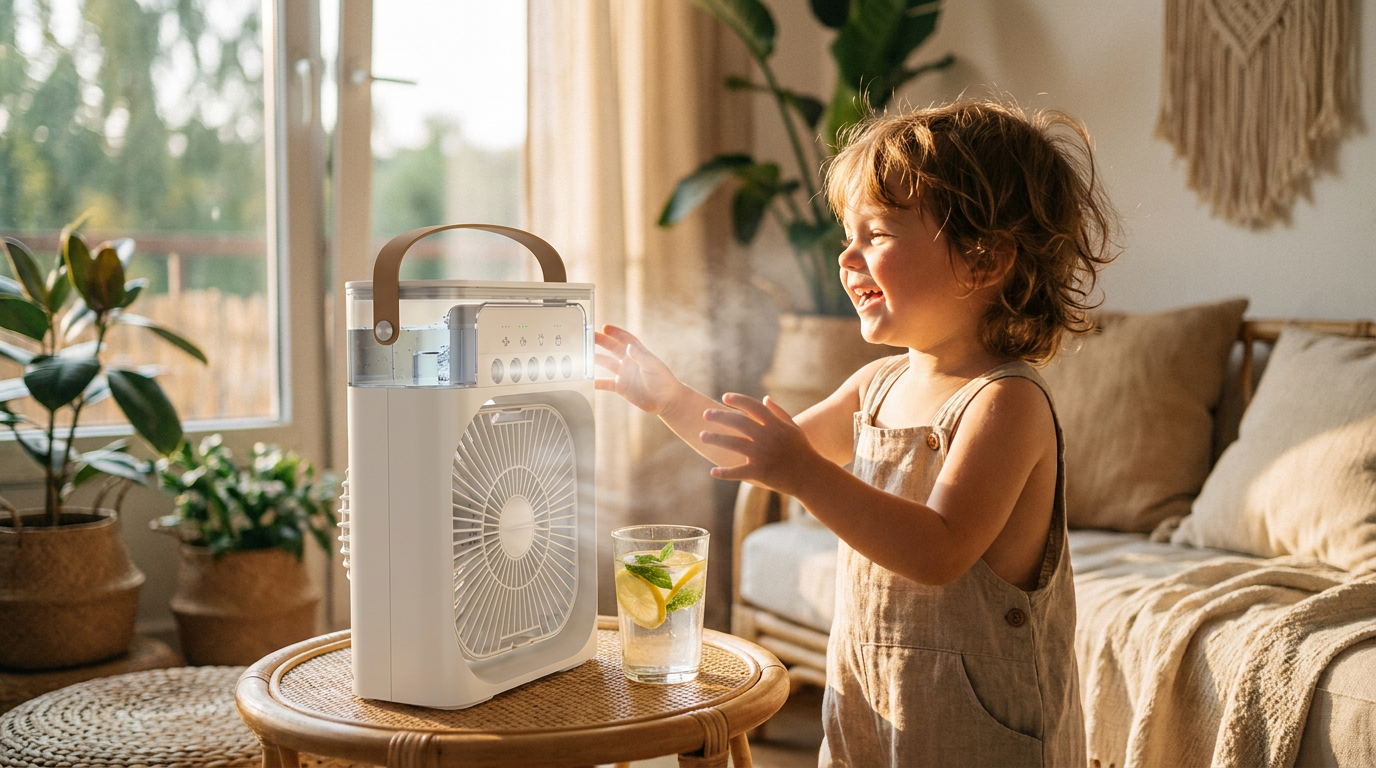
The Ventilation Mistake Killing Your Air Cooler's Efficiency
 Daniel OkaforField Tester
I've been field testing personal cooling devices for two summers, and the 3-In-1 Air Cooler immediately stood out for its low power draw. But during my initial test, I almost wrote it off. After an hour, the cool air turned… heavy. When I looked into it, our customer data showed the most common reason for poor performance is a simple mistake: using the air cooler in a sealed room, which traps humidity.
Why a Sealed Room Halts the Cooling Effect
I first set up the cooler in my 10x12 home office with the door and window shut tight. For the first 45 minutes, the cool breeze was great. But soon, the air felt thick and clammy. This happens because the device is an evaporative cooler, not a mini-AC. It works by adding water vapor to the air, and understanding how evaporative air coolers use evaporation to cool air is key. In a sealed room, the humidity level quickly rises until the air can't absorb any more moisture. At that point, the cooling process stops, and you're just left with a muggy space.
The Open Window Test: My 'Aha' Moment
Photo by Sergei Starostin on Pexels
Day three is where I noticed the real difference. I placed the 3-In-1 Air Cooler on my desk near a window I had cracked open about three inches. The change was immediate and lasting. Instead of the air getting heavier, it stayed crisp and cool all afternoon. This simple act creates a vital airflow cycle. The cooler pulls in fresh, drier air from outside to power the evaporation, and the slightly more humid, cooled air is pushed out of the room. According to the U.S. Department of Energy, providing ventilation is essential for these types of coolers to work effectively. It’s not just about the device, but where you place it in a room to create that cycle.
My Final Setup for All-Day Comfort
Here's the moment it earned its place on my desk. I positioned the cooler to pull air from my open window and blow it directly at me. This created a personal cool zone without me having to run the expensive central AC. My final setup is simple: the unit sits about three feet away, the water tank is filled with cold water (I add a few ice cubes on really hot days), and the window is always open. What I'd do differently from the start is treat it less like an AC and more like a strategic breeze machine that needs to breathe. This is also important for using the 3-In-1 Air Cooler safely in your bedroom, as good airflow prevents stuffiness.
How do I stop my air cooler from making the room feel muggy?
That muggy feeling is a sign of trapped humidity. The fix is to provide a source of fresh air by cracking open a nearby window or door. This allows the humid air to be exhausted from the room, creating an airflow cycle that lets the evaporative cooling process work continuously.
Does an evaporative cooler still work if I can't open a window?
It will provide a cooling effect, but it won't be as powerful or last as long. Without ventilation, humidity will build up and the air will eventually feel damp. If a window isn't an option, try opening the door to an adjacent hallway or larger room. This gives the humid air a place to escape, which is more effective than using it in a completely sealed space.