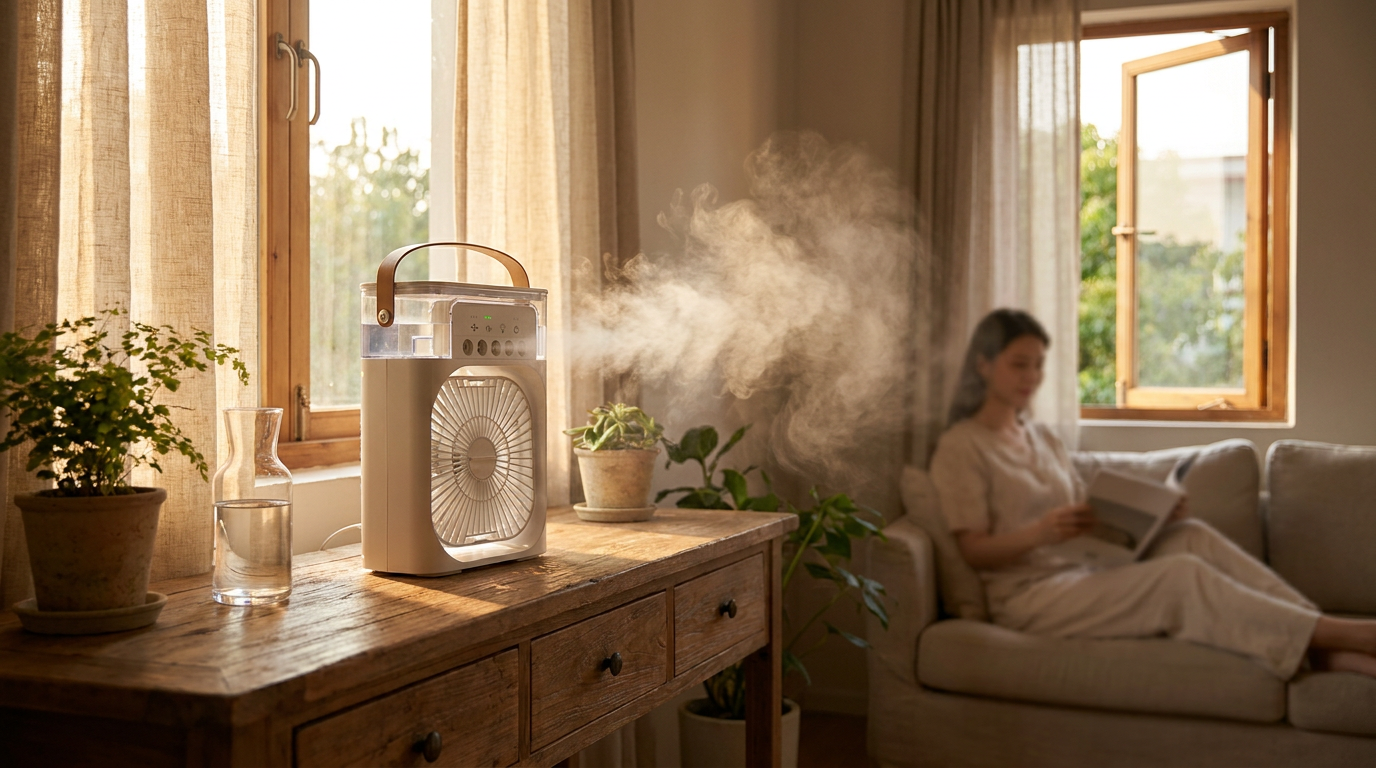
How Evaporative Air Coolers Use Evaporation to Cool Air
 Maya ChenContributing Editor
The 3-In-1 Air Cooler provides cool, refreshing air using a simple yet powerful natural process: evaporation. Unlike traditional air conditioners that use chemical refrigerants, this device leverages the cooling power of water to lower the temperature in your personal space. Understanding how evaporative air coolers work is key to getting the most out of this energy-efficient technology.
The Science Behind Evaporative Cooling
Evaporative coolers operate on a principle you’ve likely experienced—the cooling sensation of a breeze on wet skin. The process is a straightforward endothermic reaction:
According to the U.S. Department of Energy, this process can reduce air temperature by as much as 15–40°F in dry climates.
How the 3-In-1 Air Cooler Puts This Science to Work
Photo by Max Vakhtbovych on Pexels
The 3-In-1 Air Cooler is engineered to optimize this natural cooling cycle. It features a high-density cooling pad designed for maximum surface area, ensuring efficient evaporation and consistent temperature reduction. A small, low-energy pump keeps the pad continuously moist for uninterrupted performance.
Beyond just cooling, the device serves multiple functions. It operates as a standard fan for simple air circulation and as a humidifier, which is perfect for improving dry indoor air quality during any season. This versatility makes it a year-round appliance for personal comfort.
Why It's More Efficient Than Traditional AC
The primary advantage of the 3-In-1 Air Cooler is its remarkable energy efficiency. The system avoids the two most power-hungry components of a standard AC: a compressor and chemical refrigerants. Instead, it relies on a simple fan and a small water pump, consuming about as much electricity as a standard light bulb.
This makes it a cost-effective and eco-friendly choice. For a detailed breakdown, see our comparison of the 3-in-1 portable air cooler vs. traditional AC. The simple setup also means you can get it running in minutes, making it an ideal cooling solution for a home office. Our setup guide for a desktop air cooler shows just how easy it is.
How much can the 3-In-1 Air Cooler lower the temperature?

Photo by Max Vakhtbovych on Pexels
In ideal conditions with low relative humidity (under 50%), the 3-In-1 Air Cooler can drop the air temperature by 15 to 40 degrees Fahrenheit. The cooling effect is most noticeable in dry, arid climates. Performance is directly tied to the room's temperature and humidity; the hotter and drier the air, the more significant the cooling. You can explore our performance and efficiency review for more detailed insights.
Does the 3-In-1 Air Cooler need a window vent?
No, the 3-In-1 Air Cooler does not require an exhaust hose or a dedicated window vent like a portable air conditioner. However, for optimal performance, it needs a source of fresh air to prevent the room from becoming overly humid. Simply cracking a nearby window or door provides the necessary cross-ventilation, allowing the evaporative process to continue working effectively.