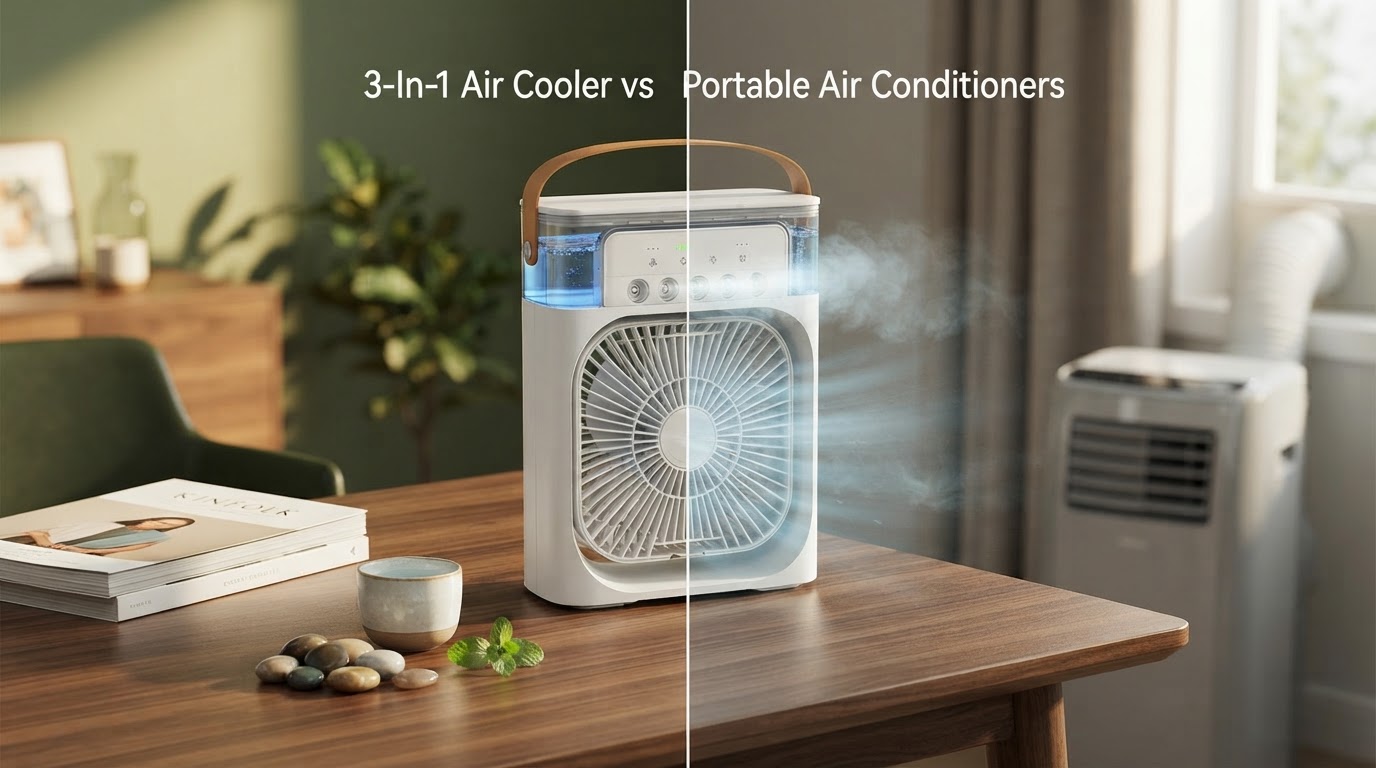
Choosing 3-In-1 Air Cooler Over High-Cost Portable AC Units
 Maya ChenContributing Editor
October 22, 2026. This technical comparison evaluates the operational differences between evaporative cooling and traditional refrigerant-based air conditioning for personal space management. It is written for consumers navigating the trade-offs between high electricity costs and localized thermal comfort.
The Efficiency Gap in Personal Cooling
The conventional wisdom says that if you want to stay cool, you need a portable air conditioner with a compressor and a venting hose. However, this ignores the thermodynamic reality of residential energy consumption. According to Evapolar, a standard portable AC unit can cost between $30 and $80 per month to operate, primarily because these machines must work against the laws of heat exchange to extract warmth from a room and pump it outside. This process is inherently energy-intensive and often overkill for a single workstation or a small bedroom. Most users searching for a mini air cooler with humidifier and fan are actually looking for localized relief, not a whole-room thermal overhaul that spikes the utility bill.
Here's the part nobody talks about: portable ACs require a sealed environment and a window for exhaust, which creates a negative pressure situation that often pulls warm air back into the room from other parts of the house. In contrast, an indoor air cooler for dry climate thrives in environments where fresh air is circulating. As noted by Honeywell Air Comfort, air coolers specifically need an open window for cross-ventilation to prevent the room from becoming overly saturated with moisture. The reliance on refrigerant in traditional ACs also introduces chemical complexities that many personal users find unnecessary for simple desk-side cooling. When we look at the physics of cooling, the movement of air and the evaporation of water provide a significantly lower barrier to entry for daily use, especially when the goal is to supplement a home that lacks central air or to provide a quiet portable cooling fan humidifier for nighttime use.
Mechanical Advantages of the 3-In-1 Air Cooler
Run the math: A 3-In-1 Air Cooler operates on a fraction of the wattage required by a compressor-based system. While a portable AC might draw 1,000 to 1,500 watts, a specialized evaporative unit like the 3-In-1 Air Cooler focuses its energy draw on a low-noise fan and a small water pump. Data from Portacool suggests that evaporative coolers can operate for as little as $1 a day, making them a fiscally responsible alternative for those who need consistent airflow without the financial burden of a refrigerant cycle. This unit functions as a mini air cooler with humidifier and fan, integrating a water tank that introduces moisture into the air stream to lower the ambient temperature through the latent heat of evaporation.
This specific 3-In-1 Air Cooler design targets the "personal zone" rather than the entire square footage of a room. This is a critical distinction because it allows for a USB-powered electric fan setup, which is far more versatile than a unit that must be tethered to a 120V wall outlet and a window vent. The inclusion of an LED night light and a water mist function adds utility that a standard AC unit simply does not offer. For users in arid regions, the humidification aspect is not a byproduct but a primary feature, addressing the dry skin and throat issues often exacerbated by the dehumidifying effect of traditional air conditioners. By utilizing a quiet portable cooling fan humidifier mechanism, the device maintains a low decibel output suitable for office environments or bedside tables, where the rhythmic hum of a compressor would be disruptive. The portability of the 3-In-1 Air Cooler means it can transition from a kitchen counter to a workspace without the need for a complex installation kit or a permanent window fixture.
Decision Framework for Cooling Technology
Choosing between these two technologies requires an honest assessment of your local climate and your specific cooling needs. An evaporative system is not a universal solution, but it is the superior choice for targeted, efficient relief in specific conditions. Use the following checklist to determine if the 3-In-1 Air Cooler is the correct hardware for your environment:
- Your local relative humidity is consistently below 60%, allowing for effective water evaporation.
- You intend to cool a personal radius (desk, bed, or chair) rather than an entire 500-square-foot room.
- You have access to a nearby window or door to allow for the necessary cross-ventilation.
- Energy conservation and a low monthly operating cost are higher priorities than achieving a specific thermostat setpoint.
- You require a multi-functional device that acts as an indoor air cooler for dry climate while providing humidification.