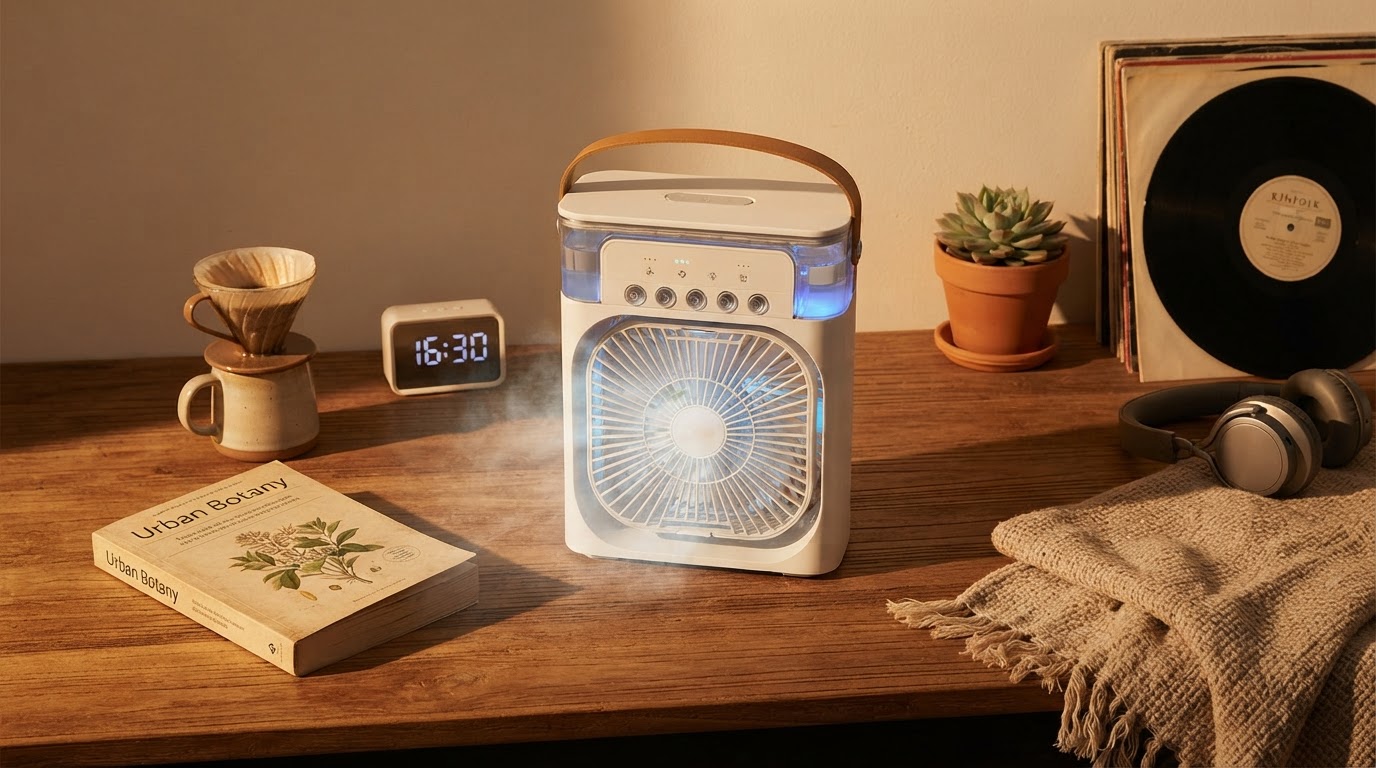
3-In-1 Air Cooler for Dorm Rooms Without Windows
 Sam VasquezBuying Guide Lead
November 2, 2026. This guide details how to maintain comfortable temperatures in windowless living spaces using localized cooling technology. It is designed for college students and renters facing strict housing regulations that prohibit traditional HVAC modifications.
The Challenge of Windowless Dorm Ventilation
Dormitories are notoriously difficult to regulate, especially in older buildings where central air is absent and windows are either non-existent or restricted. In these environments, heat from laptops, gaming consoles, and lighting builds up quickly with nowhere to escape. According to Business Insider, many housing agreements strictly forbid window-mounted units, leaving students to rely on freestanding alternatives like portable air conditioners or powerful fans. However, a standard portable AC usually requires a window for its exhaust hose to vent hot air outside. Without that exit point, a traditional portable AC actually makes the room hotter by dumping heat from the compressor directly back into the living space.
I have seen students try to "hack" this by venting into hallways or closets, but that usually leads to fines from housing authorities. If you are dealing with a truly windowless room, your primary options are high-velocity fans or evaporative cooling. A fan simply moves the existing warm air around, which helps with sweat evaporation but does not actually lower the ambient temperature. This is where the struggle for dorm room cooling solutions becomes a search for technology that does not require a hose. For those looking for a [portable ac alternative for small room](/blog/portable-ac-alternative-for-small-room) setups, the goal is to find a device that uses physics—specifically the phase change of water—to pull heat out of the air without needing a compressor or a window vent.
Using the 3-In-1 Air Cooler in Tight Spaces
The 3-In-1 Air Cooler operates as a personal evaporative cooler, meaning it uses a water tank and a cooling pad to lower the temperature of the air it blows. Unlike a standard fan, this device adds moisture to the air while cooling it. In a windowless dorm, this is effective because it provides a direct stream of chilled air to your immediate workspace or bed. Because it is a "mini air conditioner for bedroom" use-case, it lacks the heavy compressor found in window units, making it quiet enough for late-night study sessions. The device functions as a fan, a humidifier, and a cooler simultaneously, which is helpful if the building’s heating system makes the air excessively dry during the shoulder seasons.
When comparing this to other options, such as the EcoFlow Wave 3 mentioned by Business Insider, the difference is primarily about power and infrastructure. The EcoFlow is a powerhouse for RVs and camping, but it is often overkill and too expensive for a 100-square-foot dorm room. Between these two, I’d go with the 3-In-1 Air Cooler for a desk setup because it is USB-powered and doesn't require a massive battery brick. If you're on a budget, this is a much more realistic way to handle [how to stay cool without central ac](/blog/how-to-stay-cool-without-central-ac). It won't chill the entire room like a central system, but it will keep the air hitting your face and torso significantly cooler than the ambient room temperature. It also includes an LED night light, which saves space on your nightstand by combining two dorm essentials into one footprint.
Choosing the Right Cooling Strategy
Selecting a cooling device for a windowless room requires a specific framework. You have to balance noise, footprint, and the humidity levels of your geographic location. If you live in a high-humidity area like Florida, evaporative coolers are less effective because the air is already saturated with moisture. However, for students in drier climates, such as Colorado, Aire Serv suggests that improving air circulation and using portable cooling is the most effective way to manage heat. Skip this if you already have high humidity in your room, as the evaporative process will be less efficient. Here is what I'd actually buy and look for when setting up a windowless cooling station:
- Power Source: Look for USB-powered units that can run off a laptop or a power bank so you aren't hunting for a wall outlet behind a heavy dorm bed.
- Footprint: Space is at a premium. Ensure the unit is small enough to sit on a desk without displacing your textbooks.
- Tank Capacity: A larger tank means you won't have to refill it in the middle of the night.
- Multi-functionality: Since you can't easily change the room's environment, having a built-in humidifier helps when the winter heater kicks in.
- Noise Level: Ensure the decibel rating is low enough for sleeping; bladeless or small-diameter fans are generally quieter than industrial floor fans.
Sources
- Tips on cooling down a dorm with no AC? (In Colorado) Portable AC ...
- 24 Best Dorm Room Cooling Products, No AC Required - Business Insider
- 11 Ways To Cool Down a Windowless Room In Summer - YouTube