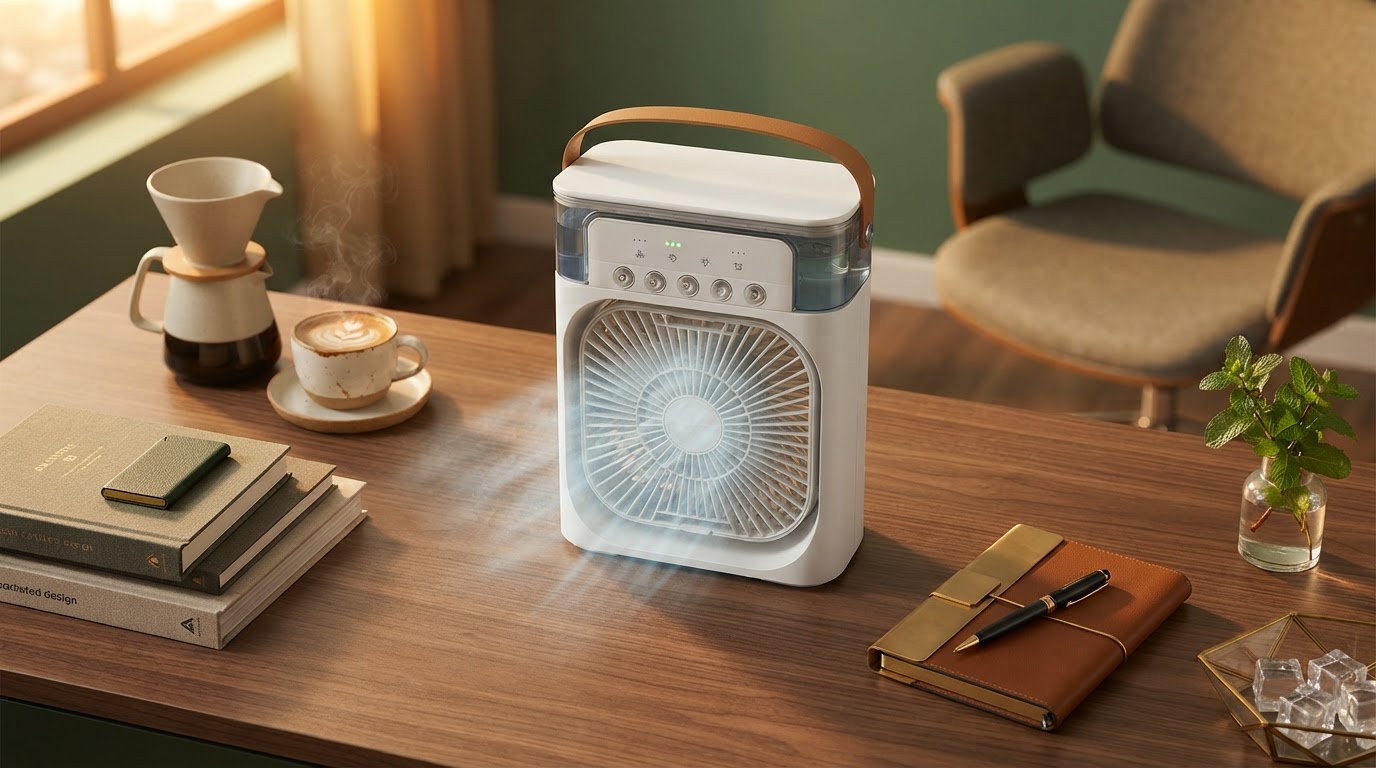
3-In-1 Air Cooler Performance for Desktop Workspace
 Maya ChenContributing Editor
August 18, 2026. This evaluation examines the thermal management capabilities of the 3-In-1 Air Cooler when deployed in close-proximity workspace environments. It is designed for professionals seeking to mitigate localized heat gain without the infrastructure requirements of centralized HVAC systems.
The Limitations of Conventional Desktop Thermal Management
The conventional wisdom says that any device pushing air will suffice for a standard office desk, yet this ignores the specific physics of localized heat pockets created by monitors and high-performance computing hardware. Standard fans merely recirculate existing ambient air, which, in a stagnant office environment, often exceeds 75 degrees Fahrenheit. According to The Telegraph, high-quality mini air coolers like the Morphy Richards Flexi Freeze 1 Litre are increasingly utilized to bridge the gap between inefficient fans and expensive fixed air conditioning. However, many consumers conflate these devices with traditional AC units. A common critique found on platforms like Quora suggests that small evaporative devices are often misunderstood; they are not intended to lower the temperature of an entire room but to provide a specific, cooled microclimate for the user. Run the math: a standard desktop fan does not account for the relative humidity needed to prevent dry eye syndrome during long shifts, nor does it provide the localized drop in air temperature necessary to counteract the heat signature of a modern workstation. This lack of moisture often leads to discomfort that users mistakenly attribute to heat, when the culprit is actually the quality of the air itself. For those in specific living situations, such as dorm room cooling solutions no window, the inability to vent hot air via a hose makes traditional portable ACs a logistical impossibility, leaving the evaporative desktop model as the only viable thermal intervention.
Technical Integration of the 3-In-1 Air Cooler
Photo by Max Vakhtbovych on Pexels
Here’s the part nobody talks about: the effectiveness of a personal cooler is entirely dependent on the proximity of the output to the user's personal breathing zone. The 3-In-1 Air Cooler addresses this by utilizing a multi-stage process that combines a high-velocity fan, an evaporative water mist system, and integrated LED lighting for visual feedback. Unlike larger units that struggle with efficiency, this device functions as a quiet portable cooling fan humidifier, ensuring that the noise floor remains below 50 decibels—a critical threshold for cognitive focus. The device utilizes a USB-powered interface, which allows it to draw power directly from a laptop or monitor hub, eliminating the need for additional wall outlets. The internal reservoir is designed for approximately 6-8 hours of continuous misting, aligning with a standard workday. When comparing this to an energy efficient spot cooler, the 3-In-1 Air Cooler prioritizes the immediate three-foot radius around the keyboard and mouse. The integration of the humidifier function is not a luxury; it is a functional necessity to prevent the dehydration of nasal passages that typically occurs with standard air conditioning. The LED night light serves as a status indicator for the device's operational mode, allowing users to verify cooling intensity without diverting attention from their screens. This targeted approach is significantly more effective than attempting to cool a 200-square-foot room with a device meant for a 2-square-foot desk.
Decision Framework for Desktop Cooling Implementation
Selecting a desktop cooling solution requires a departure from the "more BTUs is better" mindset. For a personal workspace, the objective is the management of the immediate thermal envelope. I’ll change my mind when refrigerant-based portable units can operate silently at a three-foot distance without a bulky exhaust hose, but until then, the evaporative 3-In-1 model remains the logical choice for desk-bound users. When evaluating the 3-In-1 Air Cooler against other personal air cooler options, prioritize the following technical requirements:
- Direct USB 5V compatibility to avoid cable clutter and ensure portability between workstations.
- Adjustable directional louvers to prevent air from blowing directly into the eyes, which can cause irritation.
- A minimum water tank capacity of 500ml to ensure the humidification cycle lasts through a deep-work block.
- Multi-speed fan settings to allow for adjustment based on the heat output of nearby electronics.
- Physical footprint no larger than a standard desktop speaker to maintain ergonomic workspace layout.
Sources
Photo by Max Vakhtbovych on Pexels
- Desktop air conditioner: prices on best mini desk ac cooler for work from ...
- Best air coolers in 2026, tried and tested - The Telegraph
- 10 Best Air Coolers 2026! Don't Sweat It - YouTube