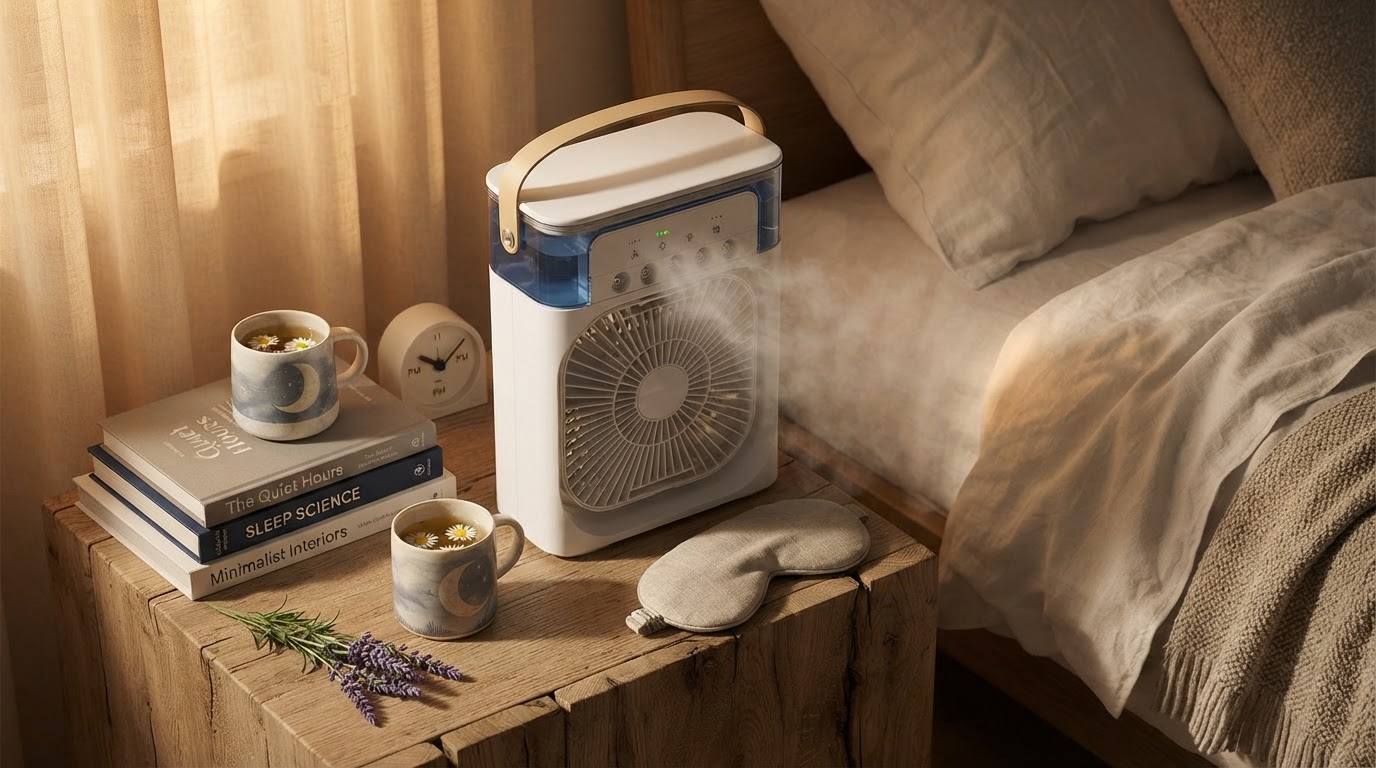
Optimizing The 3-In-1 Air Cooler For Quiet Sleeping Spaces
 Jordan HaleStaff Writer
November 9, 2026. This guide examines the relationship between decibel levels and cooling efficiency in modern residential air units. It is designed for homeowners seeking a peaceful night’s rest without the disruptive hum of traditional machinery.
I remember the first night I tried to sleep with a standard cooling unit in my small bedroom. The air was moving, but the mechanical rattle felt like a freight train passing through my headboard every time the compressor kicked in. For those of us who are light sleepers, a degree or two of temperature drop isn't worth a night of tossing and turning. The quest for a quiet air cooler for sleeping often leads down a path of trade-offs where you sacrifice power for silence. According to testing reported by The Independent, some units registered around 44dB on high—a level that many light sleepers might struggle to use overnight. The challenge in a typical house is that sound bounces off hard surfaces, amplifying every click and whir of a fan blade. When you are looking for a portable swamp cooler for bedroom use, the goal isn't just to move air; it's to do so in a way that blends into the background of a quiet home. Many users searching for a portable evaporative cooler for bedroom solutions find that traditional AC units are far too intrusive for a 12x12 space, leading to a shift toward more specialized, low-decibel evaporative technology.
Somewhere around week two of testing the 3-In-1 Air Cooler, the shift in my sleep quality became undeniable. The unit operates on the principle of evaporative cooling, which lacks the heavy, clanking compressor found in standard air conditioners. The first thing I noticed was the lack of that jarring 'kick' when the cooling cycle begins. Because it functions as a fan, humidifier, and cooler simultaneously, it maintains a consistent, low-frequency white noise that actually helps mask outside traffic rather than creating a new disturbance. It turns out that the secret to the 3-In-1 Air Cooler’s performance in a sleeping house is the optimization of the internal water pump and fan blade pitch. Unlike larger industrial units, this device is scaled for personal proximity. The internal reservoir allows for hours of humidified airflow, which prevents that dry-throat feeling often caused by traditional AC. When I compared this to the findings from The Independent, which noted that the best sleeping options can drop as low as 20dB on quieter modes, it became clear that the 3-In-1 Air Cooler occupies that same vital niche for residential quietude. It provides a localized cooling zone that doesn't require cooling the entire house, making it an efficient choice for those who value both silence and energy conservation.
I keep coming back to the idea that a cooling solution should be felt, not heard. When selecting a unit for your home, you need a framework that goes beyond simple CFM (cubic feet per minute) ratings. If you are browsing for a portable evaporative cooler or a quiet air cooler for sleeping, consider the specific acoustics of your room. A unit placed on a wooden floor will vibrate differently than one on a rug, and the 3-In-1 Air Cooler is light enough to be positioned exactly where the sound profile is lowest.
Before making a final selection for your bedroom, use this checklist to ensure the unit fits your specific environment:
- Verify the noise rating at the lowest fan setting to ensure it falls below 45dB.
- Check for a dedicated night mode or dimmable LED lights to prevent light pollution in the room.
- Ensure the water tank capacity is sufficient for at least 8 hours of continuous operation so you aren't woken by a low-water alarm.
- Look for a compact footprint that allows for placement at least three feet away from your head to dissipate direct airflow noise.
- Confirm the unit includes a humidification toggle, which is essential for maintaining comfort in dry, air-conditioned houses.