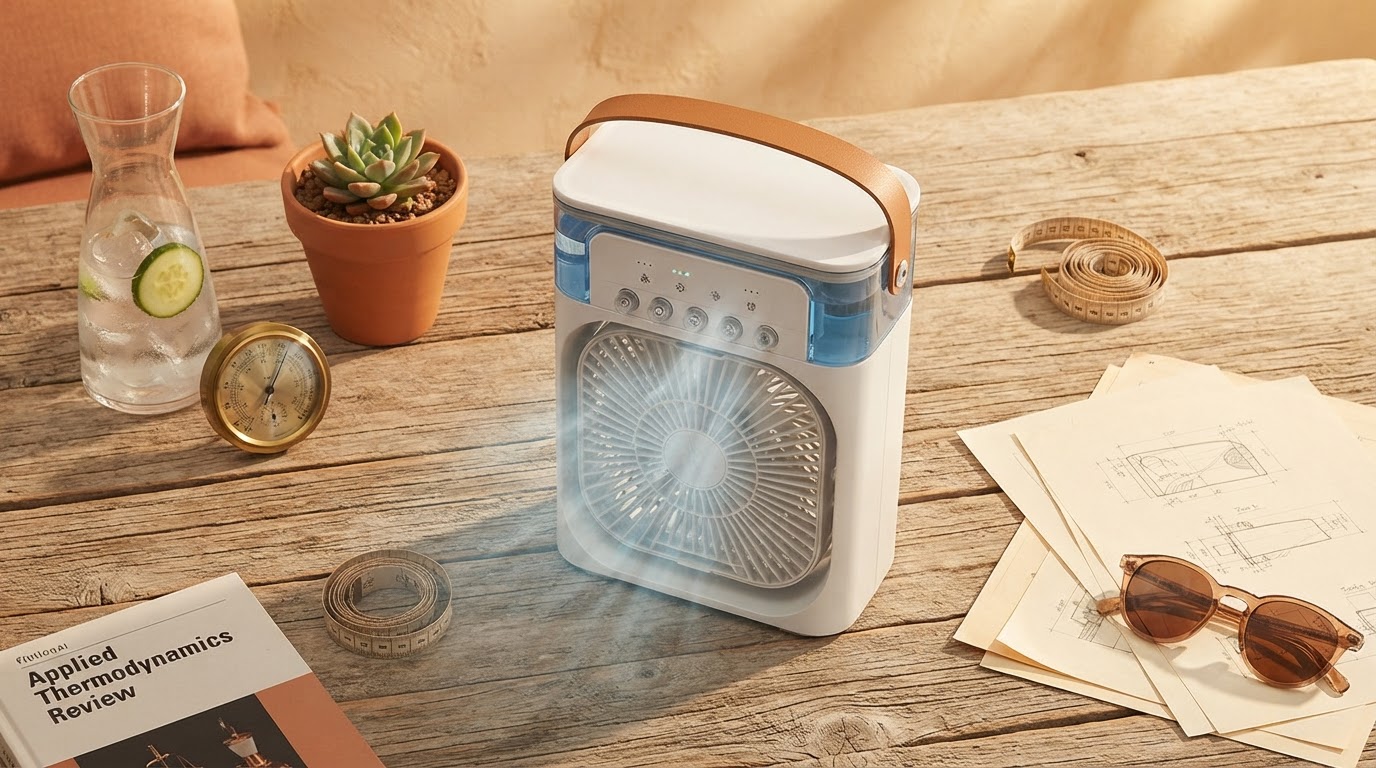
Optimizing 3-In-1 Air Cooler Performance in Arid Zones
 Maya ChenContributing Editor
November 23, 2026. This analysis examines the thermodynamic performance of the 3-In-1 Air Cooler when deployed in environments with low relative humidity. It is intended for technical-minded consumers evaluating localized cooling alternatives to traditional compressor-based systems.
The Thermodynamic Limits of Arid Cooling
The conventional wisdom says that air conditioning is the only viable path to thermal comfort in extreme heat, yet this ignores the specific physics of phase change in dry environments. In regions where relative humidity frequently drops below 30%, the energy expenditure of a standard compressor is often an exercise in inefficiency. According to the USGS (U.S. Geological Survey), an evaporative cooler can lower the air temperature by as much as 20 degrees Fahrenheit while simultaneously increasing ambient humidity. This dual-action process is critical because dry air at 95 degrees feels significantly more abrasive to the respiratory system than slightly more humid air at 75 degrees.However, most consumers misunderstand the scale required for this effect. They buy industrial-sized swamp coolers for small bedrooms, leading to localized dampness rather than comfort. The math reveals that for a personal space, a high-volume energy efficient spot cooler is often overkill. The goal is not to chill the entire structure but to manage the immediate microclimate around the user. When we look at how [portable ac vs evaporative cooler](/blog/portable-ac-vs-evaporative-cooler) comparisons usually go, they fail to account for the "Area A" designation defined by climate scientists, where the lack of moisture in the air makes the evaporative process nearly 100% efficient. In these zones, using a refrigerant-based system is essentially paying for a chemical process when a physical one—water evaporation—is freely available in the atmosphere. The inefficiency of the standard approach is staggering when you realize that a low energy cooling fan for home use can achieve similar perceived temperature drops if coupled with a controlled moisture release.
Engineering the 3-In-1 Air Cooler Response
Here's the part nobody talks about: most personal coolers fail because they don't balance airflow with water saturation. The 3-In-1 Air Cooler addresses this by integrating a three-speed fan system with a dedicated water misting function and LED night light utility. Run the math: a device that draws minimal power via USB but utilizes the latent heat of vaporization can outperform a 5,000 BTU window unit in a dry office setting without the associated noise or installation hurdles. While the Uthfy 41” Swamp Cooler cited by The Spruce offers a massive 4,800 CFM for large rooms, that volume of air movement is disruptive for a desk or bedside environment. The 3-In-1 Air Cooler focuses on a targeted delivery system, ensuring the mist is fine enough to evaporate before it saturates surfaces, a common complaint in Reddit discussions regarding personal swamp coolers for desks.This specific device is frequently categorized as a "mini air conditioner for bedroom," a term that is technically a misnomer but highlights the consumer's desire for the cooling effect without the bulk. By utilizing a USB-electric fan configuration, the 3-In-1 Air Cooler avoids the high-amperage draws that make traditional AC units expensive to operate during peak hours. It functions as a hybrid, bridging the gap between a simple fan and a complex HVAC system. The integration of the LED night light is not merely aesthetic; it serves as a low-power indicator for nighttime operation when the ambient temperature drops but the air remains uncomfortably dry. For those seeking a portable ac vs evaporative cooler alternative that doesn't require venting a hose through a window, this device utilizes the existing dry air as a fuel for its own cooling mechanism. It transforms the environment by adding exactly what the climate lacks: controlled moisture.
A Framework for Arid Climate Implementation
Choosing a cooling solution in a dry climate requires a departure from the "more power is better" mindset. Instead, one must look at the saturation efficiency and the specific needs of the immediate area. If you are operating in a region like the Southwest United States, a low energy cooling fan for home use will only move hot air around unless it is paired with an evaporative medium. The 3-In-1 Air Cooler is designed for these specific parameters, but its success depends on user implementation. I'll change my mind about the necessity of central AC when more people realize that localized humidity management is the more sustainable path forward for personal comfort. Before deploying a 3-In-1 Air Cooler, evaluate your environment against these technical requirements:- Ambient humidity must be below 50% to ensure the misting function facilitates a temperature drop rather than just increasing dampness.
- The device should be positioned within three feet of the user to maximize the "spot cooling" effect, as detailed in our guide on the energy efficient spot cooler.
- Use distilled or filtered water to prevent mineral buildup on the internal fan blades and misting nozzles, which can degrade CFM output over time.
- Ensure a source of fresh air—evaporative cooling works best with a cracked window to allow the slightly humidified air to circulate out, preventing a greenhouse effect.
- Utilize the USB power source to maintain mobility, allowing the unit to transition from a desk during the day to a nightstand in the evening.
Sources
- The 7 Best Evaporative Air Coolers to Cool Your Home This Summer
- Evaporative coolers work best in the dry areas of the U.S. (Area A)
- Best Evaporative (Swamp) Coolers for Dry Climates (2026)